A difficult aspect of working with fabrics is how to calculate the fabric yardage needs. Whether it's on window treatments or on upholstered furniture, understanding how the fabric repeat effects the yardage required is paramount. Underestimating can mean not having enough fabric to do the job and over estimating can mean significant added expense. In fact, this is also true when working with wallpaper, although the calculations are different.
For those who don't know, the repeat is the size of the pattern as it appears once on a piece of fabric. This is measured vertically and horizontally. Many decorator fabric samples come with the repeats listed, especially if you're working with the fabric house or a decorator. However, when buying at retail, often the repeats are not referenced and you will need to measure yourself, or hope the sales person is able to provide the information.
 It's really pretty easy. Spread out the fabric, making sure you have a large enough piece to see the full repeat and then some. Determine the pattern from side-to-side and from top-to-bottom. As you can see above, I have determined that the horizonal repeat runs across 3 flowers: 1 large and two smaller. Measuring from the center of the pattern, to the next time that same pattern appears, I have a measurement above of approximately 18.5" across (horizontally).
 Do the same up-and-down and you have the vertical repeat, which is 11-3/4".
Often, when we are quoted yardage requirements for a particular application (furniture, window treatment) assume that if you have not provided the repeat information, then you are getting a quote for plain material that has no repeat. The chart below shows how much extra fabric is needed depending the repeat you are using.
 So, for the fabric above that has a vertical repeat of 11-3/4" and a horizontal repeat of 18.5", your total repeat is 31" (rounding up). If you are told you need 10 yards of plain 54" fabric, then to use the fabric above, you will need to order an additional 25% or 12.5 total yards. Make sense?
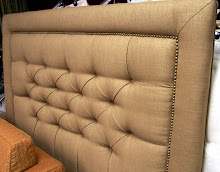
So, why, you may ask, is the repeat so very important? Because, quality workmanship dictates that the pattern matches. This means that the flowers line up across seam lines and other breaks. If you notice, the damask pattern on the top of this upholstered headboard continues across the break of border to padded middle section. Without enough fabric, your upholsterer or seamstress is not able to match the patterns and the result will be amateurish.
 A little tip when selecting fabric - the larger the repeat, the more fabric is required to do the job. Obviously, the more fabric you buy, the more you spend. So, if you are looking for a way to do a job in the most economical way, a smaller repeat will save money. This can really make a difference if your job takes 25 yards of fabric and your fabric is $100/yard or more. An additional 6 yards of fabric (25% of 25 yards) at $100/yard is an additional $600.00 you may or may not wish to spend.
In a followup post, we're going to talk about the placement of pattern. We're currently recovering a standard wing chair in a very cool batik fabric that has a bold pattern. How the fabric is placed will make the difference between blah and wow!
For those who don't know, the repeat is the size of the pattern as it appears once on a piece of fabric. This is measured vertically and horizontally. Many decorator fabric samples come with the repeats listed, especially if you're working with the fabric house or a decorator. However, when buying at retail, often the repeats are not referenced and you will need to measure yourself, or hope the sales person is able to provide the information.
 It's really pretty easy. Spread out the fabric, making sure you have a large enough piece to see the full repeat and then some. Determine the pattern from side-to-side and from top-to-bottom. As you can see above, I have determined that the horizonal repeat runs across 3 flowers: 1 large and two smaller. Measuring from the center of the pattern, to the next time that same pattern appears, I have a measurement above of approximately 18.5" across (horizontally).
 Do the same up-and-down and you have the vertical repeat, which is 11-3/4".
Often, when we are quoted yardage requirements for a particular application (furniture, window treatment) assume that if you have not provided the repeat information, then you are getting a quote for plain material that has no repeat. The chart below shows how much extra fabric is needed depending the repeat you are using.
 So, for the fabric above that has a vertical repeat of 11-3/4" and a horizontal repeat of 18.5", your total repeat is 31" (rounding up). If you are told you need 10 yards of plain 54" fabric, then to use the fabric above, you will need to order an additional 25% or 12.5 total yards. Make sense?
So, why, you may ask, is the repeat so very important? Because, quality workmanship dictates that the pattern matches. This means that the flowers line up across seam lines and other breaks. If you notice, the damask pattern on the top of this upholstered headboard continues across the break of border to padded middle section. Without enough fabric, your upholsterer or seamstress is not able to match the patterns and the result will be amateurish.
A little tip when selecting fabric - the larger the repeat, the more fabric is required to do the job. Obviously, the more fabric you buy, the more you spend. So, if you are looking for a way to do a job in the most economical way, a smaller repeat will save money. This can really make a difference if your job takes 25 yards of fabric and your fabric is $100/yard or more. An additional 6 yards of fabric (25% of 25 yards) at $100/yard is an additional $600.00 you may or may not wish to spend.In a followup post, we're going to talk about the placement of pattern. We're currently recovering a standard wing chair in a very cool batik fabric that has a bold pattern. How the fabric is placed will make the difference between blah and wow!